
What Motivated China’s Dual-Use Strategy in Space: Historical and Strategic Drivers
The Yinhe, a Chinese civilian container ship, was scheduled to travel to Kuwait, with stops in Singapore, Jakarta, and Dubai. But it never reached those destinations.
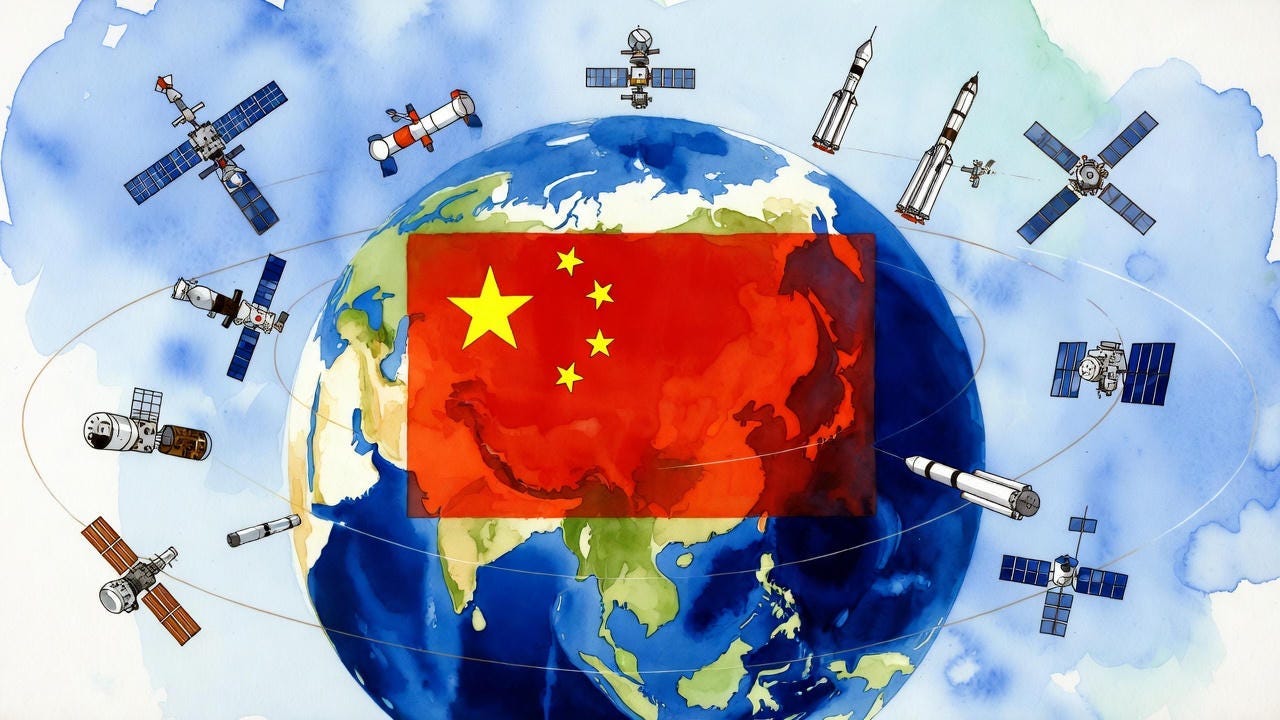
In late July 1993, a Chinese civilian container ship (The Yinhe) was sailing through the Indian Ocean. The ship’s crew had no idea that this voyage would later be remembered as one of the events that prompted China to accelerate the development of its own satellite navigation system, BeiDou.
The Yinhe was scheduled to travel to Kuwait, with stops in Singapore, Jakarta, and Dubai. But it never reached those destinations.
Suddenly, international media began reporting a dramatic story: the U.S. government, via the CIA, claimed that the Yinhe was carrying materials that could be used to produce chemical weapons. According to U.S. intelligence, the ship’s final destination was Iran. Washington pressed Middle Eastern ports to deny docking rights to the Yinhe — and one by one, ports across the region refused entry.
China vehemently rejected all allegations and initially refused to allow any inspection of the vessel, not anticipating that the U.S. held a powerful leverage point: control over GPS.
After China denied inspection, the U.S. allegedly disabled or jammed the Yinhe’s GPS navigation support, leaving the large container ship essentially “blind” in the middle of the ocean. As a result, it drifted and remained stranded on the high seas for twenty-four days, unable to navigate safely until China ultimately agreed to inspection.
During this period, the crew suffered shortages of water, fuel, and basic supplies. Eventually, following protests from Beijing and a joint Saudi–U.S. inspection that found no chemical-weapon precursors on board, the ship was cleared and allowed to return to China.
The incident became a turning point. It prompted China to fundamentally rethink its supply-chain security and accelerated its efforts to build an independent satellite navigation system — later known as BeiDou.
The Yinhe affair exemplifies how external constraints and security risks partially motivated China to pursue autonomy in space-related dual-use technologies.
Today, China has a clear ambition not only to rival the United States but also to present itself to the Global South as a capable, independent space power. This raises important questions:
What drives China to pursue such an ambitious dual-use strategy in space? What are the strategic motivations — domestic and external — that have shaped the implementation of its Military-Civil Fusion (MCF) strategy in space technology development?
In this blog post, we examine China’s motivations to challenge the space dominance of the United States and the broader Global North, particularly in dual-use technologies and critical space infrastructure.
A foundational motivation is China’s desire to avoid “single-point” dependencies — such as reliance on foreign GNSS systems, advanced sensors, and key semiconductors — that could be denied during a crisis. Strategic autonomy in navigation, timing, and space-based services reduces operational vulnerability for both civilian and military systems. The Yinhe incident is widely cited in Chinese policy discourse as a humiliating episode that underscored this vulnerability and helped catalyze the quest for indigenous satellite navigation.
Military modernization is another central driver. China regards space capabilities — navigation, surveillance, communications, remote sensing — as force multipliers. Integrating civilian R&D and commercial industrial capacity shortens technology cycles and speeds the development of advanced dual-use systems for the People’s Liberation Army. Xi Jinping elevated MCF to a national-level strategic priority in 2015, explicitly linking civilian technological innovation and industrial strength to national defense objectives.
At its core, China’s MCF strategy in space is motivated by national ambitions for technological and military leadership, while U.S. restrictions and international scrutiny act as significant external drivers and constraints. MCF is central to Xi’s broader vision of the “great rejuvenation of the Chinese nation,” which seeks to make China wealthy, strong, and globally respected by mid-century. The goal is to transition from a “major space power” to a “strong space power” capable of rivaling or surpassing the U.S. in space capabilities.
China also views space technologies as vital for national security, economic growth, and international prestige. Possession of global navigation capacity and ground-station networks gives China considerable leverage abroad and enhances its geopolitical influence. Control over space-based infrastructure is not only a strategic asset but also a tool for diplomacy and soft power. Systems such as BeiDou, along with indigenous launch capabilities and remote-sensing networks, strengthen China’s ability to expand its influence through commercial partnerships and civil diplomacy while contesting U.S. technological predominance.
Another important motivation involves using dual-use technologies to activate the entire national innovation ecosystem. China’s MCF strategy is designed to create a platform that links military and civilian sectors, enabling the transfer of mature technologies across domains. This integrated approach is believed to catalyze innovation, accelerate commercialization, and promote economic development. The underlying philosophy is that military and civilian technological advances can be mutually reinforcing.
Finally, China considers export controls, technology denial, and sanctions to be serious long-term threats to national security. Since the early 2000s — and especially after the mid-2010s — U.S. export control regimes (ITAR, EAR, Entity List) and allied measures have tightened restrictions on China’s access to advanced semiconductors, precision fabrication tools, space components, and mission-critical software. These constraints created what Chinese strategists increasingly view as an unbearable strategic dependence on foreign suppliers, thereby incentivizing the rapid development of domestic alternatives.
In essence, China — much like the United States and European countries — views its space program through a dual-use lens that deliberately links military necessity and civilian prosperity. Technological innovation is treated as mutually reinforcing across both sectors. Through MCF, China ensures that advances in the strategic space domain generate significant technological and economic benefits for the civilian economy, while civilian innovations simultaneously strengthen military capabilities.
Resources:
Can, M., & Vieira, A., 2022. The Chinese Military-Civil Fusion Strategy: A State Action Theory Perspective. The International Spectator, 57, pp. 85–102. https://doi.org/10.1080/03932729.2022.2080262
E, C., & Arrow, U., 2023. Modernization and the Military-Civil Fusion Strategy.
Nie, M., 2020. Space Privatization in China’s National Strategy of Military-Civilian Integration: An Appraisal of Critical Legal Challenges. Space Policy, 52, pp. 101372. https://doi.org/10.1016/j.spacepol.2020.101372
Masuo, C., 2021. China’s “National Spatial Infrastructure” and global governance: Chinese way of Military–Civil Fusion (MCF) over the ocean. Maritime Affairs: Journal of the National Maritime Foundation of India, 17, pp. 27–42. https://doi.org/10.1080/09733159.2021.2024383
Bitzinger, R., 2021. China’s Shift from Civil-Military Integration to Military-Civil Fusion. Asia Policy, 28, pp. 24–5. https://doi.org/10.1353/asp.2021.0001
Pollpeter, K., 2020. China’s Space Program: Making China Strong, Rich, and Respected. Asia Policy, 27, pp. 12–18. https://doi.org/10.1353/asp.2020.0027
Wu, X., & Long, J., 2022. Assessing the Particularity and Potentiality of Civil–Military Integration Strategy for Space Activities in China. Space Policy. https://doi.org/10.1016/j.spacepol.2022.101514
Pollpeter, K., 2023. Innovation in China’s space industry: overcoming decoupling. Asian Security, 19, pp. 114–128. https://doi.org/10.1080/14799855.2023.2256241
Duchâtel, M., 2023. Europe’s China Problem: How Not to Feed Beijing’s Military–Civil Fusion. Survival, 65, pp. 55–78. https://doi.org/10.1080/00396338.2023.2239059
Evron, Y., 2021. China’s Military-Civil Fusion and Military Procurement. Asia Policy, 28, pp. 25–44. https://doi.org/10.1353/asp.2021.0002
Jash, A., 2020. China’s Military-Civil Fusion Strategy: Building a Strong Nation with a Strong Military, 13, pp. 42–62.
Yang, Z., 2021. Opening Up While Closing Up: Balancing China’s State Secrecy Needs and Military-Civil Fusion. Asia Policy, 28, pp. 45–64. https://doi.org/10.1353/asp.2021.0003
Rome, N., 2023. China’s Space Export Strategy. Space Policy. https://doi.org/10.1016/j.spacepol.2023.101574
Military-civil fusion will strengthen China’s military. Emerald Expert Briefings. https://doi.org/10.1108/oxan-db254866
Sarjito, A., 2024. NATIONAL STRATEGY FOR DEVELOPING COMPETITIVE ADVANTAGE THROUGH MILITARY-CIVIL FUSION. Journal of Social Politics and Governance (JSPG). https://doi.org/10.24076/jspg.v6i1.1527
Thanks for reading Seyithan'in Substack'i! Subscribe for free to receive new posts and support my work.